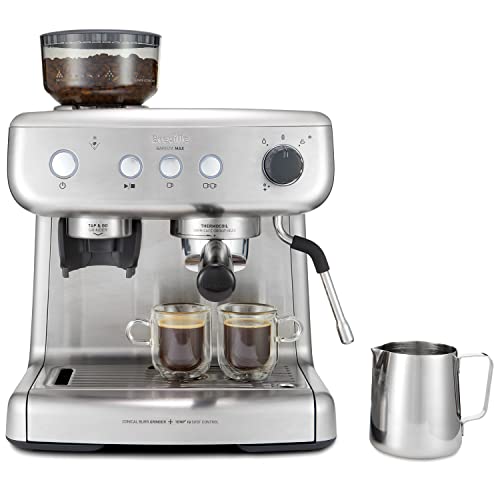

The Breville Barista Max at a competitive price and the Sage Barista Express at a competitive price are often cross-shopped by UK buyers who notice they share the "Barista" name. The Breville UK brand and Sage are not the same company despite a confusing shared heritage: Sage is Australian Breville's UK brand name, while UK Breville (the £300 Barista Max) is owned by Russell Hobbs. Different machines, different companies, different design philosophies.
This comparison covers what UK buyers are actually choosing between, and whether the £199 saving on the Breville Barista Max represents fair value.
Quick Verdict
The Breville Barista Max wins on price, on a 2.8-litre water tank that's larger than typical home machines, and on getting started in home espresso for under £300.
The Sage Barista Express wins on customer satisfaction track record (comparable customer ratings, a meaningful gap), brand specialisation in espresso, and a stronger upgrade path through the wider Sage Barista family.
The deciding factor: budget. If £499 is at the edge of your budget the Breville delivers credible home espresso for £199 less. If £499 is comfortable, the Sage is the better machine.
Side-by-Side Specs
| Spec | Breville Barista Max | Sage Barista Express |
|---|---|---|
| UK price (Amazon) | £300 | £499 |
| Built-in grinder | Yes, integrated bean grinder | Yes, conical burr |
| Milk system | Manual steam wand | Manual steam wand |
| Coffee input | Whole beans | Whole beans |
| Water tank | 2.8 L | Not specified |
| Pump | 15 bar Italian pump | Standard |
| Body | Stainless steel | Brushed stainless steel |
| Power | 1,100 W | Not specified |
Note: Breville UK (Russell Hobbs) is a separate company from Sage (Australian Breville). The "Breville" name in the UK refers to different products in different markets. The Barista Max is a UK Breville product, not related to Sage's Barista Express.
Price and UK Availability
Both widely stocked at Amazon UK, Currys, John Lewis, and AO. The Breville is also available through Argos and Sainsbury's Tu Home, broader high-street distribution than the Sage.
The £199 price gap is substantial. For buyers on a tight budget, this is the difference between starting home espresso this month or waiting six months. For buyers with flexibility, the gap funds better beans, accessories, or a grinder upgrade on top of the Sage.
Design and Build Quality
The Breville Barista Max is a competent stainless steel machine designed for the mainstream UK kitchen-appliance market. It looks like a stainless steel kettle's bigger sibling: clean, conventional, recognisable. The large 2.8-litre water tank is a notable feature for households making many drinks per day.
The Sage Barista Express has the brushed stainless steel Sage house style. Functional, more refined visual finish, better-considered control layout and feedback.
Build quality reflects price. The Breville is appropriate for its £300 segment but uses more plastic in non-critical paths and lighter-gauge metal than the Sage. The Sage's heavier construction and refined controls justify part of the £199 premium.
For long-term durability expectations: the Breville should give 5 to 8 years of reliable home use. The Sage should give 8 to 12 years.
Espresso Shot Quality
Both machines produce home espresso. The Breville suggests a higher rate of dissatisfaction than the Sage. Both ratings are well within the "good machine" range, but the difference is real and reflected in user reports of grinder consistency and brew temperature stability.
The Breville's "15 bar Italian pump" is standard espresso machine specification - actual brewing happens at approximately 9 bar at the puck on both machines. The 15-bar rating is marketing language common to most home espresso machines and doesn't differentiate the two.
The Sage's higher rating likely reflects better grinder consistency and more refined dose control rather than meaningfully different shot quality at peak. Both machines produce respectable espresso when dialled in.
Built-in Grinder
Both have integrated burr grinders. The Sage typically offers more grind settings than the Breville. Both dose directly into the portafilter.
For buyers using a single bean type consistently, 8 grind settings is sufficient. For buyers experimenting with multiple beans or single-origin coffees that need finer adjustment, the Sage's wider range is a practical advantage.
Both grinders remove the £150 to £400 separate grinder upgrade decision. This is the main reason buyers pick either machine over a Gaggia Classic Evo Pro or similar grinderless option.
Milk Frothing
Both machines use manual steam wands. Both require manual technique. Both produce microfoam with practice.
Steam pressure on the Sage is slightly higher than on the Breville, which makes microfoam easier to produce once you have technique. The Breville's lower steam pressure is more forgiving for beginners but slower to texture milk.
Neither is automatic. Skill transfers between machines.
Daily Operation and Learning Curve
Both warm up in 2 to 5 minutes from cold. Both produce a shot in under 90 seconds once warm. Both require the same fundamental skills (grind, dose, tamp, brew, steam).
The Sage's interface gives more feedback and is more refined in operation. The Breville is functional and clean but less considered in detail. For first-time home espresso buyers, the Breville is approachable. For buyers who appreciate refined operation, the Sage feels noticeably better in daily use.
The Breville's 2.8-litre water tank is genuinely useful for households making 6+ drinks per day. The Sage requires more frequent water refills.
Cleaning and Maintenance
Similar daily and weekly cleaning. Drip tray, steam wand, portafilter, group head wipe. Weekly backflush. Monthly descale.
The Sage has more developed cleaning cycle prompts. The Breville has basic indicator lights for descaling.
Annual maintenance cost is roughly £15 to £30 for either. Both accept generic descaling solution though manufacturer-branded products are recommended for warranty preservation.
Who Should Buy the Breville Barista Max
You'll enjoy the Barista Max if your budget caps at £300 to £350 and you want integrated-grinder espresso at that price; or if your household makes many drinks per day and the 2.8-litre water tank capacity matters; or if you want a mainstream UK kitchen-appliance brand from Currys, Argos, or John Lewis with broad high-street support.
Skip the Barista Max if you can stretch to £499 for the Sage (the customer satisfaction gap is real), or if you want the more refined grinder workflow and wider grind adjustment, or if you anticipate growing into more advanced home barista techniques.
Who Should Buy the Sage Barista Express
You'll enjoy the Barista Express if customer satisfaction track record matters to you (many reviews is a strong signal); or if you want the more refined operation and wider grind adjustment range; or if you anticipate possibly upgrading to a Sage Barista Pro or Touch later (shared accessories and portafilter standards); or if espresso is more than a casual kitchen-appliance purchase for you.
Skip the Barista Express if the £199 saving on the Breville is meaningful to your budget, or if you don't need the refinement Sage delivers, or if you prefer mainstream high-street brand distribution.
Final Verdict
For UK buyers on a tight budget, the Breville Barista Max is a credible entry into home espresso. £300 with an integrated grinder is excellent value, and well-rated, which indicates most buyers are reasonably satisfied. The Breville is the right machine for first-time home espresso buyers exploring the category.
For UK buyers who can comfortably afford £499, the Sage Barista Express is materially better. The rating gap is substantial when both machines have hundreds of reviews. The more refined operation and broader product family support the premium.
The Breville wins price-sensitive buyers. The Sage wins quality-focused buyers.
For deeper coverage see our Breville Barista Max review and Sage Barista Express review.
Frequently Asked Questions
Are Breville and Sage the same company?
No. UK Breville (which makes the Barista Max at a competitive price) is owned by Russell Hobbs. Sage is the UK brand name for Australian Breville (which makes the Barista Express at a competitive price). They share the "Breville" word in their corporate history but are now separate companies producing different machines for different segments.
Is the £199 price gap worth it?
For budget-conscious buyers, no - the Breville delivers credible home espresso for £199 less. For buyers who can comfortably afford the gap, yes - the Sage's higher customer satisfaction rating and more refined operation justify the premium.
Which has a better grinder?
The Sage has more grind settings (typically 16+ versus the Breville's narrower range) and is generally regarded as having more consistent grind output. The Breville's grinder is adequate for home use but less refined.
Which is louder?
Both have similar pump noise during extraction. The Sage's grinder is slightly faster and louder; the Breville's grinder runs a bit slower and quieter. Neither is loud enough to wake a sleeping household.
Will either replace a bean-to-cup machine?
Neither. Both require manual portafilter handling and manual milk steaming. For one-button workflow look at fully automatic bean-to-cup machines instead. See our espresso machine vs bean-to-cup guide for that comparison.
Compare to Other Alternatives
Still deciding? See how this machine stacks up against the alternatives UK buyers consider: