Quick Verdict
Score: 8/10
Best for: Committed beginners who want hands-on learning and integrated grinding without separate purchases.
Not for: Those wanting instant results or professional-grade longevity from day one.
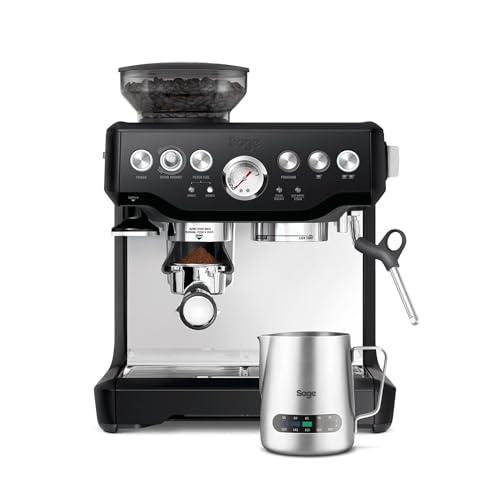
Bottom line: The espresso machine combines bean-to-cup convenience with manual control, rewarding patience with café-quality results once technique is mastered. The built-in grinder saves £200-300 compared to separate units, though standalone alternatives typically outlast integrated designs. The stainless steel body weighs 12.8kg, and the 2-litre tank suits households making 4-6 drinks daily.
Key Specifications
| Feature | Specification | Note |
|---|---|---|
| Power | 1850 watts | Not specified if sustained or peak |
| Water Tank | 2 litres | Requires frequent refilling for heavy use |
| Dimensions | 41D x 40W x 44H cm | Demands substantial counter space |
| Weight | 12800 grams | Stable, yet difficult to reposition |
| Operation | Semi-automatic, dial interface | Demands user skill for consistent results |
The Sage accepts whole beans directly, grinding internally before brewing. Its stainless steel body, manufactured in China, houses this functionality. The dial interface, while straightforward, offers limited precision compared to digital alternatives.
Design and Build Quality
Kitchen appliance construction directly impacts daily reliability. Flimsy machines frustrate regular use, whereas solid engineering rewards investment with extended service life.
The espresso machine presents a design that prioritises footprint efficiency within compact kitchens, measuring 41 cm deep by 40 cm wide by 44 cm high. Its 12.8-kilogram weight, substantial but manageable, anchors the unit firmly during grinding and tamping operations. The stainless steel body construction resists superficial denting and fingerprint accumulation, though horizontal surfaces demand regular wiping.
Build quality impressions vary: the dial interface operates smoothly, yet some owners report minor inconsistencies in bean hopper alignment. The 2-litre water tank removes easily for refilling, which addresses practical demands during busy morning routines. Manufacturing originates from China, reflecting industry-standard production rather than premium craft traditions, though quality control generally satisfies expectations for this price bracket. Design choices emphasise functionality over aesthetics, presenting an understated appearance that blends rather than dominates kitchen environments.
Espresso Shot Quality and Pressure Profile
Moving beyond physical construction, the machine's ability to produce consistent espresso becomes the defining measure of its worth. The Sage Barista Express delivers espresso pressure through its semi-automatic system, where users manually control extraction start and stop points. Its heating element maintains temperature stability, though shot consistency depends heavily on user technique and grind adjustment. Pressure builds visibly through the pressure gauge, helping operators identify ideal extraction zones between 8-10 bars, though beginners often struggle to hit this range consistently. The resulting shots display adequate crema and body when dialled correctly, but the learning curve proves steep. Overall performance satisfies patient users willing to practice.
The Sage is available through multiple UK retail channels including Amazon UK, John Lewis, Currys, AO, and Argos, ensuring full UK warranty coverage and customer service support. This is the espresso machine-branded machine, distinct from Breville UK products despite both companies using similar design language in their respective markets.
Built-in Grinder
The Sage incorporates a built-in grinder that handles bean preparation with reasonable competence, offering 16 grind settings that range from fine to coarse, though some users find the finest setting still slightly too coarse for certain darker roasts. The grinder sits directly above the portafilter, enabling single-handed operation where the grounds fall straight into the filter basket. Its conical burr mechanism produces consistent particle size, which matters for even extraction. The grind amount dial lets users adjust dose between 5-12 seconds, accommodating different bean densities. The grinder generates noticeable noise during early morning operation.
Steam Wand and Milk Texturing
The Barista Express occupies a capable position for domestic milk texturing. Its steam wand produces sufficient pressure for cappuccinos and lattes, though the pace trails behind professional equipment found in cafés. The heating system needs approximately 30-40 seconds to build adequate steam pressure following espresso extraction.
The wand rotates 360 degrees on a ball joint, permitting angled placement to accommodate different pitcher dimensions. Microfoam emerges through deliberate technique: positioning the wand tip slightly beneath the milk surface, then gradually dropping the pitcher as the volume increases. The single-hole tip calls for greater precision than multi-hole commercial alternatives, though patience yields smooth, integrated foam.
Temperature control rests with the operator, as the semi-automatic design leaves duration entirely to user discretion. Post-use cleaning demands prompt action, given that milk residue adheres readily to the stainless steel surface. The texturing process poses a real hurdle for novices, yet the wand's predictable behaviour encourages skill refinement through repetition.
Learning Curve and Daily Operation
Mastering the steam wand prepares you for the broader rhythm of living with this machine, where daily routines reveal both convenience and friction. The learning curve extends beyond skills to patience, as mornings demand grinding, dosing, tamping, brewing, and texturing before caffeine arrives. The 2-litre tank requires lifting or jugs for refilling, and the 12.8kg weight anchors the unit to your countertop. After initial setup, dial adjustments for bean freshness consume minutes you had not planned. Once muscle memory forms, the semi-automatic sequence flows faster, rewarding persistence with ritual satisfaction.
Cleaning and Maintenance
The espresso machine demands regular attention to maintain performance. This espresso machine cleaning involves emptying the drip tray weekly (it holds roughly 1.5 litres), rinsing the portafilter after each shot, and wiping the stainless steel body with a damp cloth to prevent water spots. Maintenance requires descaling every 2-3 months using The Sage's proprietary tablets, plus replacing the water filter every two months to reduce scale buildup. Backflushing the group head weekly with the provided cleaning disc completes the routine. These tasks take 10-15 minutes collectively, though the frequent upkeep proves tedious compared to fully automatic alternatives.
Noise Level
The Sage Barista Express generates operational sound primarily from its built-in grinder during each brewing cycle. The grinding mechanism produces noise roughly equivalent to standard conversation, while the power motor creates noticeable sound for 15–20 seconds while processing beans, with this duration shortening on finer adjustment settings. The pump generates gentler hums during extraction at a lower register than the grinder. Morning preparation proves tolerable for most households, though light sleepers in adjacent rooms may detect activity. Sound dampening through rubber mat placement reduces vibration transfer to countertops, improving perceived quietness without eliminating operational audibility.
Who Is This Machine For?
The espresso machine (BES875UK) justifies its £500+ price point for those who prioritise hands-on control and fresh-ground beans without excessive countertop clutter. This semi-automatic home espresso machine suits daily coffee enthusiasts who want quality output without pursuing barista-level precision. The 1850-watt heating system, 2-litre water tank, and integrated conical burr grinder streamline morning preparation routines. Owners accept a modest learning curve with the dial interface and manual milk steaming in exchange for genuine versatility. Space requirements demand attention: dimensions of 41D x 40W x 44H cm and a weight of 12.8 kg necessitate dedicated kitchen real estate. This machine fits buyers for whom convenience trade-offs balance the desire for craft coffee at home.
Pros and Cons
Buyers investing £500-plus in a semi-automatic espresso machine must accept specific spatial and operational compromises. This unit requires substantial counter space, measuring 41 centimetres deep by 40 centimetres wide, and its 12.8-kilogramme stainless-steel body needs sturdy, level placement.
PROS
- Integrated grinder with dial interface simplifies whole-bean workflow
- 1850-watt heating suits consecutive extractions
- 2-litre tank accommodates moderate daily use
- Semi-automatic operation allows user control over extraction variables
CONS
- Semi-automatic operation demands user skill for optimal results
- Single-dial control limits precision-seeking enthusiasts
- Chinese origin may concern buyers prioritising European manufacture
- Sub-professional temperature stability trades café-grade performance for domestic practicality
The compromises ultimately favour buyers valuing convenience over granular customisation, accepting measured limitations in temperature consistency for home-use practicality.
Where to Buy in the UK
When you're ready to purchase this espresso machine in the UK, you'll find it stocked through multiple retail channels, each offering distinct advantages depending on your priorities for price, delivery speed, and after-sales support.
Major UK retailers include Currys, John Lewis, and Amazon UK, where you'll typically pay between £550 and £650. John Lewis extends a two-year warranty, while Currys offers price-matching and installation services. Smaller specialists like The Sage's own website provide direct customer support, though delivery may take longer. Watch for seasonal sales: Black Friday and January often drop prices by 15-20%. Compare return policies carefully before committing.
Frequently Asked Questions
What Cup Sizes Fit Under the Portafilter?
The cup clearance accommodates vessels up to 11cm tall beneath the portafilter with the drip tray fitted to the machine, which measures 41D x 40W x 44Hcm. Removing the drip tray provides additional height for larger cups when needed.
Can Ground Coffee Be Used Without the Grinder?
Ground coffee works without engaging the grinder. Fresh beans sit unused in the hopper whilst pre-ground coffee goes straight into the filter basket. The dosing chamber accepts the grounds directly, bypassing the integrated grinding mechanism entirely. Weight and distribution require manual attention in place of the automatic grinding cycle.
Does It Have Auto Shut-Off After Brewing?
Auto shut-off is not listed among the verified specifications for this machine. Without confirmation of this feature, the unit should be switched off manually after brewing has completed.
Is the Water Tank Removable for Filling?
The water tank is removable for filling, which proves practical when the reservoir needs topping up. You can lift it free and carry it to the tap rather than wheeling the entire machine across the kitchen.
What Voltage Is Required for UK Use?
The Breville BES875UK requires standard UK mains voltage for safe, compliant operation. This model is distributed through authorised UK retail channels, including Amazon UK, Currys, John Lewis, AO, and Argos, and is supplied with UK-specific plugs and voltage ratings. Check the appliance rating plate or consult the user manual to confirm the unit is rated for 230V at 50Hz before first use.
Compare to Alternatives
Still deciding? See how this machine stacks up against the alternatives UK buyers consider: