
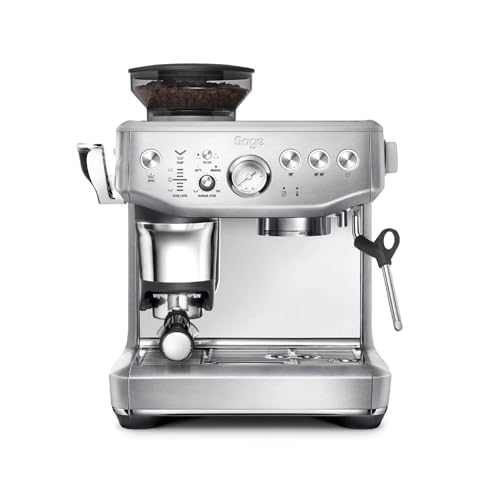
The Sage Barista Express at a competitive price and the Sage Barista Express Impress at a competitive price share a name for good reason - they're the same machine concept with one major addition on the Impress: automatic tamping. The Impress has Sage's Impress Puck System that auto-doses, auto-tamps, and auto-aligns the portafilter, removing two of the biggest variables in home espresso.
This comparison covers whether automatic tamping is worth £230.
Quick Verdict
The Sage Barista Express wins on value and on the satisfaction of manual tamping for buyers who enjoy the home barista craft.
The Sage Barista Express Impress wins on consistency, beginner-friendliness, and removing the tamp-pressure variable from your daily routine.
The deciding factor is whether you find manual tamping rewarding or whether you'd rather have one less variable to manage. Beginners benefit more from the Impress; enthusiasts often prefer the standard Express.
Side-by-Side Specs
| Spec | Sage Barista Express | Sage Barista Express Impress |
|---|---|---|
| UK price (Amazon) | £499 | £729 |
| Built-in grinder | Yes, conical burr | Yes, conical burr |
| Tamping | Manual (hand-held tamper) | Automatic (Impress Puck System) |
| Milk system | Manual steam wand | Manual steam wand |
| Coffee input | Whole beans | Whole beans |
| Display | Analogue dials + pressure gauge | Updated dials |
| Body | Brushed stainless steel | Brushed stainless steel |
Detailed dimensional specs (water tank, exact width, wattage, boiler type) are not consistently published in the Amazon UK listings.
Price and UK Availability
Both stocked at Amazon UK, Currys, John Lewis, and AO. The standard Barista Express has been in the market for years and runs sale promotions frequently. The Express Impress is the newer model with fewer discount events; it typically holds closer to list price.
The £230 gap is the cost of removing manual tamping from your daily workflow.
Design and Build Quality
Both share the brushed stainless steel finish, top-mounted bean hopper, integrated grinder cradle, and steam wand on the right.
The visible difference is the portafilter dock area. The Express has a standard cradle where you remove the portafilter, tamp manually with a separate hand tamper, then lock the portafilter into the group head. The Impress has the Impress Puck System: you place the portafilter in the dock, the machine doses, and a built-in lever-action mechanism tamps the puck automatically at the correct pressure.
Build quality is the Sage premium standard on both. Both repair through Sage UK service centres.
Espresso Shot Quality
Both machines produce comparable shot quality when used correctly. The Impress's automatic tamping eliminates dose-to-dose variation caused by inconsistent manual tamping pressure - a real source of shot inconsistency for less-experienced home baristas.
For experienced users who tamp consistently (around 30 lb of pressure, level surface), the Impress provides no meaningful shot quality improvement. For beginners and inconsistent tampers, the Impress materially improves shot consistency.
Both machines share the same brewing pressure, brew temperature, and grinder. The espresso ceiling is the same on both.
Built-in Grinder
Both have integrated conical burr grinders feeding the portafilter directly. Same grind setting range and adjustment mechanism on both.
The Impress's puck system handles dosing automatically once the grinder has fed the portafilter, while the standard Express relies on you eyeballing the dose volume during grinding.
For buyers without an existing grinder, either machine removes the £150 to £400 separate grinder purchase entirely.
Milk Frothing
Both use manual steam wands. Identical milk frothing experience and learning curve. No automatic frothing on either machine.
If milk drinks are your main focus and you want automation, neither machine is the right choice. Look at the Sage Barista Touch (auto-frother) or Sage Bambino Plus (compact auto-frother) instead.
Daily Operation and Learning Curve
The standard Express requires you to learn three key skills: grind dialling, dose volume, and tamp pressure. The third one - consistent tamping at the right pressure - is the most variable for beginners and the slowest to develop.
The Express Impress removes the tamping skill entirely. The Impress Puck System handles dosing and tamping in a single integrated motion. Beginners reach consistent shot quality much faster.
For experienced home baristas the Impress's automatic tamping can feel like a step backward - you lose the tactile feedback of manual tamping and the ability to feel the puck resistance. Some enthusiasts specifically prefer the standard Express for this reason.
Both have the same warm-up time and brewing speed.
Cleaning and Maintenance
Similar regimes on both. Daily: drip tray empty, steam wand wipe. Weekly: backflush group head. Monthly: descale per UK water hardness.
The Impress's automatic tamping mechanism adds slightly more maintenance complexity. The puck removal step requires a specific motion the standard Express doesn't have. Sage publishes guidance on cleaning the Impress mechanism every few weeks.
Annual maintenance cost is roughly £20 to £40 for either machine. The Impress is marginally higher due to the additional mechanism cleaning.
Who Should Buy the Sage Barista Express
You'll enjoy the Express if you want the most affordable Barista Express experience; or if you enjoy manual tamping as part of the home barista craft; or if you're prepared to develop tamping skill over months; or if you want a Sage machine with the largest installed base and longest track record; or if you'd rather invest the £230 saving in better beans or accessories.
Skip the Express if tamping consistency frustrates you, or if you're a beginner who wants reliable shots from day one, or if multiple household members will use the machine and you want consistent results regardless of skill.
Who Should Buy the Sage Barista Express Impress
You'll enjoy the Express Impress if you want consistent shot quality without learning manual tamping; or if you're a beginner who wants reliable espresso from week one; or if multiple household members will use the machine and you want consistent results regardless of skill; or if your tamping has been inconsistent and you want to remove that variable; or if you appreciate Sage's newer engineering generation.
Skip the Express Impress if you enjoy manual tamping, or if you've already developed consistent tamping technique, or if the £230 has a better home (premium beans, better grinder, etc.).
Final Verdict
For UK buyers new to home espresso or who have struggled with tamping consistency, the Sage Barista Express Impress at a competitive price is genuinely worth the upgrade. Removing the tamping variable significantly speeds up the learning curve and produces more consistent daily shots.
For experienced home baristas or buyers who treat espresso preparation as a craft to learn, the Sage Barista Express at a competitive price remains the better choice. The £230 saving funds better beans or accessories, and the manual tamping ritual is part of the experience for many enthusiasts.
The Impress is the future of mainstream home espresso. The standard Express is the proven workhorse.
For deeper context see our Sage Barista Express review and Sage Barista Express Impress review. For the upgrade-tier comparison see Sage Barista Express vs Barista Pro.
Frequently Asked Questions
Is automatic tamping really worth £230?
For beginners and inconsistent tampers, yes - it materially improves shot consistency from day one. For experienced home baristas who tamp consistently, no - the espresso quality is the same and you lose tactile control.
Does the Impress produce better shots than the Express?
For users with inconsistent tamping technique, yes. For users with consistent tamping technique, no. The brewing path, pressure, and grinder are identical on both machines.
Can I tamp manually on the Impress?
The Impress Puck System integrates tamping into the workflow - you cannot easily bypass it to tamp manually. If you want manual tamping control, buy the standard Express.
Will the Impress mechanism wear out faster than the standard Express?
The Impress has more moving parts than the standard Express, which theoretically introduces more potential failure points. Sage warranty covers both equally; long-term reliability data on the Impress is still developing as it's a newer model. The standard Express has a longer track record.
Which has better resale value?
Both Sage Barista machines hold value reasonably on UK second-hand markets. The standard Express typically resells at 50 to 65 percent of original retail. The Impress is newer with less established second-hand pricing but expected to track similarly or slightly lower as it's a less common model.
Compare to Other Alternatives
Still deciding? See how this machine stacks up against the alternatives UK buyers consider: