
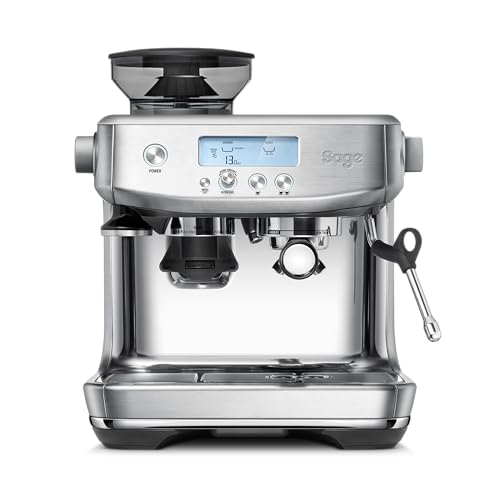
The Sage Barista Express at a competitive price and the Sage Barista Pro at a competitive price are the same product family at two different price points. Same Sage design language, same integrated burr grinder, same steam wand, same portafilter cradle. The Pro is what the Express looks like after three product generations of refinement.
This comparison covers what the extra £230 actually buys and whether it changes your daily experience enough to matter.
Quick Verdict
The Sage Barista Express wins if you want the Barista line at the lowest price and don't mind a longer warm-up.
The Sage Barista Pro wins if you make multiple drinks in a row, want a faster morning workflow, or value the digital display for grinder and shot timing precision.
The deciding factor is how often you make back-to-back drinks. The Pro's faster heat-up makes a real difference if you brew three drinks in fifteen minutes. The Express is fine if you make one drink and walk away.
Side-by-Side Specs
| Spec | Sage Barista Express | Sage Barista Pro |
|---|---|---|
| UK price (Amazon) | £499 | £729 |
| Built-in grinder | Yes, conical burr | Yes, conical burr |
| Milk system | Manual steam wand | Manual steam wand |
| Coffee input | Whole beans | Whole beans |
| Body | Brushed stainless steel | Brushed stainless steel |
| Display | Analogue pressure gauge | Digital LCD |
Detailed dimensional specs (water tank, exact width, wattage, boiler type) are not consistently published in the Amazon UK listings for either machine. Both share the same Sage Barista chassis with the integrated bean hopper and grinder feeding into the front portafilter cradle.
Price and UK Availability
Both are widely stocked at Amazon UK, Currys, John Lewis, and AO. Sage often runs promotions on the Express that can drop it below £450, while the Pro typically holds closer to its £729 list price.
The £230 gap is what you pay for the upgrade from the original Barista Express design to the refined Barista Pro design. Sage positions the Pro as the mid-tier of the Barista line, sitting between the entry Express and the premium Barista Touch.
Design and Build Quality
Both machines share the same brushed stainless steel body, top-mounted bean hopper, integrated grinder cradle, and right-side steam wand. The footprint is essentially identical.
The visible design differences are on the front fascia: the Express has analogue dials and an analogue pressure gauge during extraction; the Pro has a digital LCD display showing shot time, temperature, and machine status.
Build quality is the same Sage standard. Both are repairable through Sage UK service centres. Replacement parts (steam wand seals, portafilter baskets, grinder burrs) are available from Sage UK and authorised retailers.
Espresso Shot Quality
Both machines produce comparable shot quality from the same beans. Same grind quality from the burr grinder, same brew pressure, similar brewing temperature.
The Pro has Sage's ThermoJet heating system, which Sage publishes as faster heat-up than the Express's standard thermocoil. In practice this manifests as: the Pro is ready to brew faster from cold start. Shot temperature in steady state is similar between the two machines.
The Pro's digital shot timer (displayed on the LCD) makes it easier to consistently pull shots in the target 25 to 30 second window. The Express requires you to time the shot yourself or eyeball the analogue gauge.
For a single shot, the difference is small. For consistency across many shots over months, the Pro's timing display is a genuine practical advantage.
Built-in Grinder
Both have integrated conical burr grinders with adjustable grind size, dose control, and direct-to-portafilter grinding. Same fundamental grinder hardware.
The Pro's grinder integrates with the digital display: grind time is shown numerically and can be adjusted precisely. The Express uses a dose dial that's calibrated by volume rather than time. In practice both produce consistent doses once dialled in.
For buyers without an existing grinder, both machines remove the £150 to £400 grinder upgrade decision entirely. Both grinders are good enough to extract decent shots from quality beans, though neither matches what a dedicated £500+ grinder can do.
Milk Frothing
Both machines use manual steam wands with similar steam pressure and wand geometry. Neither has automatic or one-touch frothing.
Microfoam quality and learning curve are essentially the same. The steam wand placement is similar on both machines, and the skills transfer identically.
If milk drinks are your main focus and you don't want to learn manual steaming, neither machine is the right choice. Look at the Sage Bambino Plus for compact auto-frothing or the Sage Barista Touch for full automation including milk.
Daily Operation and Learning Curve
The Express takes 3 to 5 minutes from cold start to ready-to-brew. The Pro is faster, typically under 30 seconds from power on to first shot, thanks to the ThermoJet heating.
For a single morning drink, this is a minor convenience. For a household making three or four drinks in succession at breakfast, the Pro's faster recovery between shots adds up to real time saved.
The Pro's digital display also makes the workflow more discoverable: you can see exactly where you are in the process, what the current temperature is, and how long the shot has been pouring. The Express requires more muscle memory and visual judgement.
Learning curve is the same on both. Both expect you to manage grind, dose, tamp, brew, and milk yourself. The Pro just gives you better feedback while you do it.
Cleaning and Maintenance
Same cleaning regime on both machines. Daily: empty drip tray, wipe steam wand, purge after milk steaming. Weekly: backflush group head, brush out grinder. Monthly: descale based on UK water hardness.
The Pro's digital display includes cleaning cycle reminders that are more proactive than the Express's analogue indicators. This is a small quality-of-life improvement.
Annual maintenance cost is roughly £20 to £40 in descaling solution, cleaning tablets, and replacement filters. Identical for both machines.
Who Should Buy the Sage Barista Express
You'll enjoy the Express if you want the Sage Barista experience at the lowest price; or if you only make one or two drinks per morning and don't need fast recovery between shots; or if you find analogue gauges and dials more intuitive than digital displays; or if you regularly catch Sage's sale promotions that drop the Express below £450.
Skip the Express if you make multiple drinks in succession, or if shot-timing consistency matters to you, or if you want the most refined version of the Barista line.
Who Should Buy the Sage Barista Pro
You'll enjoy the Pro if you make several drinks in a row (household of two or more); or if you want the fastest heat-up in the Sage Barista line; or if you appreciate digital feedback on shot times and grinder dose; or if you're an enthusiast who wants the more refined version of a proven design.
Skip the Pro if budget is tight and the Express performs the same espresso-making task at lower price, or if you specifically prefer analogue controls.
Final Verdict
For most UK home buyers, the Sage Barista Express is the better-value choice. Espresso quality is the same as the Pro. The £230 gap funds a useful grinder upgrade or a year of premium coffee beans rather than ThermoJet heating and a digital display.
For households making multiple drinks in quick succession, or for enthusiasts who want the cleaner workflow, the Sage Barista Pro is worth the upgrade. The faster heat-up genuinely changes your morning experience if you make three drinks in fifteen minutes.
The Express has been the better commercial seller for years because most buyers fit the "one or two drinks per morning" profile. The Pro wins enthusiasts and busy households.
For deeper context, see our full Sage Barista Express review and Sage Barista Pro review. For the next-tier upgrade, see our Sage Barista Touch review.
Frequently Asked Questions
Is the Barista Pro worth £230 more than the Barista Express?
It is worth the upgrade if you make multiple drinks in succession or if you value the digital display's shot timing and grinder feedback. It is not worth the upgrade for buyers who make one drink per morning and find analogue controls perfectly readable.
Do they produce different espresso quality?
No, not meaningfully. Same grinder, same brew path, similar brew temperature in steady state. The Pro is faster from cold start and has better timing tools, but the espresso in the cup is essentially identical from the same beans.
Which is easier for beginners?
The Pro, slightly. The digital display shows shot time and temperature, which makes it easier to learn what a good shot looks like and to repeat it. The Express requires you to watch the analogue gauge and time shots yourself. Both are forgiving for beginners thanks to the integrated grinder.
Do they use the same accessories?
Both use 54mm portafilters, so accessories and baskets are interchangeable. Both accept the same Sage cleaning tablets and descaling solution. Burr grinder replacement parts are model-specific but available from Sage UK service.
Can I upgrade from the Express to the Pro later?
There is no direct upgrade path - they are separate machines. If you start with the Express and later decide you want the Pro, you'd sell the Express (good resale for Sage machines on eBay and Gumtree, typically 50 to 65 percent of original retail) and buy the Pro fresh. Total cost of that path is higher than buying the Pro outright.
Compare to Other Alternatives
Still deciding? See how this machine stacks up against the alternatives UK buyers consider: