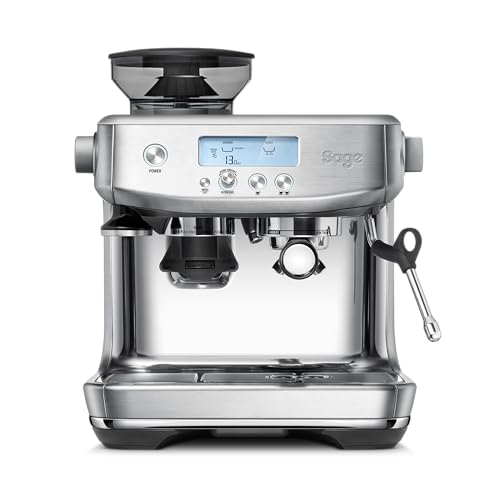

The Sage Barista Pro at a competitive price and the Sage Barista Touch at a competitive price are the mid and premium tiers of Sage's manual-espresso-with-integrated-grinder line. Both have the same fundamental brewing hardware, same conical burr grinder, same ThermoJet heating. The difference is interface and milk automation.
This comparison covers what the £262 upgrade actually delivers and whether it's worth paying.
Quick Verdict
The Sage Barista Pro wins on value for buyers comfortable with manual milk steaming and digital LCD-based controls.
The Sage Barista Touch wins for buyers who want auto-frothing milk and a colour touchscreen workflow rather than monochrome LCD and dial-based controls.
The deciding factor is milk handling. If you're happy steaming milk manually on the Pro, save the £262. If you want one-button milk drinks, pay the upgrade.
Side-by-Side Specs
| Spec | Sage Barista Pro | Sage Barista Touch |
|---|---|---|
| UK price (Amazon) | £729 | £991 |
| Built-in grinder | Yes, conical burr | Yes, conical burr |
| Milk system | Manual steam wand | Auto-frother (touchscreen-controlled) |
| Coffee input | Whole beans | Whole beans |
| Display | Digital LCD | Colour touchscreen |
| Heat-up | ThermoJet (~3 sec) | ThermoJet (~3 sec) |
| Body | Brushed stainless steel | Brushed stainless steel |
Detailed dimensional specs (water tank, exact width, wattage, boiler type) are not consistently published in the Amazon UK listings.
Price and UK Availability
Both widely stocked at Amazon UK, Currys, John Lewis, and AO. The Pro runs sale promotions more frequently than the Touch and can be found below £650 during Black Friday or Boxing Day. The Touch typically holds closer to £991 list.
The £262 gap is the within-Sage upgrade premium between the mid and flagship tiers of the Barista line.
Design and Build Quality
Both share the brushed stainless steel finish, top-mounted bean hopper, integrated grinder cradle, and similar overall footprint.
The Pro has a monochrome digital LCD on the front fascia showing shot time, temperature, and basic machine status. The Touch has a full colour touchscreen with drink presets, programmable profiles, and step-by-step prompts.
The Touch's auto-frother attaches to the steam wand position - the Pro uses a conventional manual steam wand at the same location.
Build quality is the Sage premium standard on both. Both repair through Sage UK service centres.
Espresso Shot Quality
Both produce comparable shot quality. Both have the ThermoJet heating system (very fast warm-up from cold), the same grinder, the same brew path. Espresso from the same beans on either machine would be indistinguishable in a blind taste test.
The Touch's profile-saving capability is the only differentiator for shot consistency: you can save custom temperature and brew-time settings per bean type and recall them with one tap. The Pro requires manual adjustment each time.
For buyers using a single bean type consistently, this profile feature has limited value. For buyers swapping between multiple beans, it's a real workflow improvement.
Built-in Grinder
Same conical burr grinder hardware on both. Same multi-setting adjustment capability.
The Touch's grinder integrates with the touchscreen for dose-time adjustment in precise increments. The Pro uses the LCD with simpler dose-time numerical adjustment.
For practical purposes, the grinder experience is essentially identical between the two machines.
Milk Frothing
This is the meaningful difference between the two machines.
The Barista Pro has a manual steam wand. Conventional milk steaming - you control depth, angle, and timing. Microfoam quality depends on your technique. With 2 to 6 weeks of daily practice you produce silky milk capable of latte art.
The Barista Touch has an automatic milk frothing system controlled by the touchscreen. Pour cold milk into the supplied jug, attach to the wand, select drink type, and the machine textures milk automatically to the right temperature and consistency for that drink.
For buyers who want consistent café-quality milk drinks from day one, the Touch's auto-frother is the single feature that justifies most of the £262 premium.
Daily Operation and Learning Curve
Both warm up in roughly 3 seconds (same ThermoJet system). Both produce a shot in under 60 seconds once warm.
The Pro's workflow: select dose, grind into portafilter, tamp, lock in, brew. Steam milk manually if making a milk drink. Total time for a flat white: 2 to 3 minutes.
The Touch's workflow: select drink on touchscreen, place portafilter (machine auto-doses), tamp, lock in, press start. Auto-froth milk while espresso brews. Total time for a flat white: under 90 seconds.
The Touch is materially faster for milk drinks and easier for buyers who don't want to learn manual steaming. The Pro is faster than the Express because of ThermoJet but requires the same milk-steaming skill.
Cleaning and Maintenance
Both follow the same regime. Daily: drip tray empty. Weekly: backflush group head. Monthly: descale per UK water hardness.
The Touch's auto-frother adds a daily milk-jug cleaning step. The Pro's manual steam wand needs only a wipe and steam purge after milk use.
Both machines have automatic descaling cycle prompts. The Touch's touchscreen walks through the cycle step by step; the Pro's LCD provides numerical prompts.
Annual maintenance cost is roughly £25 to £45 for either. The Touch is slightly higher due to the auto-frother cleaning requirements.
Who Should Buy the Sage Barista Pro
You'll enjoy the Pro if you want a Sage premium machine without paying for the touchscreen and auto-frother; or if you enjoy manual milk steaming or want to learn the skill; or if a digital LCD with dials suits your preference better than a touchscreen; or if budget matters and the Pro at £729 is comfortably within reach where the Touch at a competitive price isn't.
Skip the Pro if you specifically want auto-frothing milk, or if a colour touchscreen workflow appeals to you over LCD controls.
Who Should Buy the Sage Barista Touch
You'll enjoy the Touch if you want effortless milk drinks (the auto-frother is its defining feature); or if you value touchscreen interfaces and drink presets; or if multiple household members will use the machine and you want consistent results regardless of skill; or if you make multiple milk drinks per day where the Pro's manual steaming becomes a bottleneck.
Skip the Touch if you enjoy manual milk steaming as part of the craft, or if the £262 saving has a better home (better beans, better grinder, or just staying in your pocket).
Final Verdict
For UK buyers comfortable with manual milk steaming, the Sage Barista Pro is the better value. The £262 saving is meaningful and the espresso quality is identical to the Touch's. Most home enthusiasts who care about manual barista technique prefer the Pro.
For UK buyers who want effortless milk drinks above all else, the Sage Barista Touch is worth the premium. The auto-frother genuinely changes daily use, particularly in households making multiple milk-based drinks.
The Pro wins more enthusiasts. The Touch wins more convenience-focused households.
For deeper context see our Sage Barista Pro review and Sage Barista Touch review. For the entry tier comparison see Sage Barista Express vs Barista Touch.
Frequently Asked Questions
Is the Touch worth £262 more than the Pro?
It is worth the upgrade if you specifically want auto-frothing milk and the touchscreen workflow. It is not worth the upgrade if you're happy steaming milk manually and prefer digital LCD controls. The espresso quality is the same on both.
Are the grinders the same?
The hardware is essentially the same conical burr grinder. The interfaces differ (touchscreen vs LCD) but the actual grind output from the same beans is comparable. Grind setting count and adjustment range are similar.
Do they share accessories?
Both use 54mm portafilters so baskets and accessories are interchangeable. Both accept the same Sage cleaning tablets and descaling solution.
Which is faster for milk drinks?
The Touch decisively. The auto-frother textures milk in roughly 30 seconds without any user intervention. The Pro's manual steam wand requires you to texture milk yourself, which adds 30 to 60 seconds plus the time required to develop the skill.
Which has better resale value?
Both Sage premium machines hold value reasonably on UK second-hand markets (eBay, Gumtree). The Pro typically resells at 50 to 60 percent of retail; the Touch at 45 to 55 percent. The Pro's longer track record (more years in market) makes it slightly easier to sell second-hand.
Compare to Other Alternatives
Still deciding? See how this machine stacks up against the alternatives UK buyers consider: