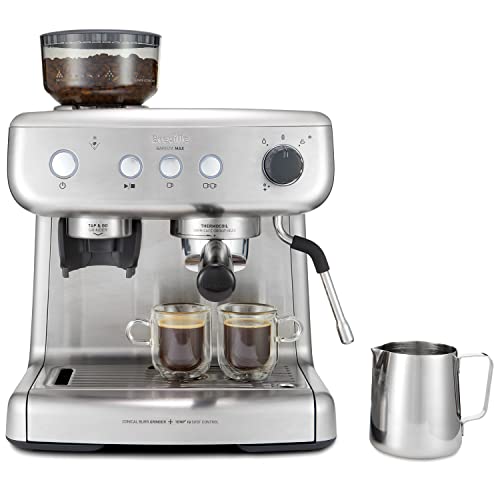
Quick Verdict
The Breville occupies a specific niche in the UK espresso machine market. It suits buyers who prioritise hands-on control and value over automated convenience, offering genuinely capable brewing at a price point below feature-heavy competitors.
Build quality centres on a 2.8-litre water tank, sufficient for daily home use without constant refilling. The stainless steel body and 1100-watt heating element deliver stable performance, while the 7.75kg weight suggests decent internal componentry. The 31cm footprint accommodates most kitchen worktops without dominating the space.
Manual operation defines the experience. You handle dosing, tamping, and extraction timing yourself. This demands practice but rewards with genuine flexibility. The absence of programmable presets found in pricier machines reflects cost positioning rather than oversight.
Manufacture takes place in China, not Europe. For some buyers, this carries weight. For others, the solid construction and available UK retailer support through Amazon UK, Currys, John Lewis, AO, and Argos provide adequate reassurance.
Key Specifications
The practical capabilities of the espresso machine become clearer when examining its core specifications. This espresso machine operates with sufficient power for home use, though its manual operation demands user skill. The generous water reservoir reduces refill frequency, which benefits households preparing multiple drinks daily.
| Feature | Specification |
|---|---|
| Power | 1100 watts |
| Water Capacity | 2.8 litres |
| Weight | 7.75 kg |
The dimensions require dedicated counter space. Stainless steel construction suggests durability. These specifications position the unit as a mid-range option, balancing capacity with footprint, though button interface limits programming precision compared to touch-screen alternatives.
Design and Build Quality
This espresso machine occupies 31D x 31W x 41Hcm on the countertop, its 7.75-kilogram stainless steel body providing substantial stability during operation. The design and build quality reflect practical considerations: a 2.8-litre water tank reduces refill frequency, while button-based manual operation prioritises reliability over complexity. The compact footprint suits smaller kitchens, though the squared dimensions demand precise placement. Stainless steel construction resists daily wear, though fingerprints require regular attention. For users prioritising durability without premium aesthetics, the Barista Max delivers functional, unpretentious engineering that withstands consistent morning use.
Espresso Shot Quality and Pressure Profile
The Breville Barista Max is available through established UK retail channels including Amazon UK, Currys, John Lewis, AO, and Argos. This machine operates through a straightforward manual process that rewards attention to grind size and tamping consistency. The portafilter requires firm, level tamping for balanced extraction. Shot quality varies considerably; newcomers produce thin, acidic pulls, while experienced hands achieve respectable body and crema through dialled-in grind settings. Without pressure profiling or PID control, consistency relies entirely on user technique, making this manual approach equally rewarding and demanding.
Built-in Grinder
Convenience in this machine comes with measured trade-offs. The Barista Max incorporates a built-in grinder that eliminates countertop clutter, though it demands precise adjustment for optimal results. Operators use button-based controls to select grind settings, which range across multiple stepped intervals for bean-to-cup preparation. The 2.8-litre water tank supports extended grinding sessions without constant refilling. However, the manual operation requires attention: inconsistent tamping or grind selection produces uneven extraction. The stainless steel construction houses the mechanism. For daily use, the built-in grinder suffices, but enthusiasts may notice limitations in consistency compared to dedicated standalone units.
Steam Wand and Milk Texturing
Beyond grinding, the Barista Max addresses milk preparation through its integrated steam wand, which operates via the same button-controlled interface found throughout the machine. Users activate the steam wand through a dedicated button press, after which they will wait approximately 30-45 seconds for sufficient pressure to build for milk texturing. The steam wand, positioned on the machine's left side, pivots through roughly 180 degrees, accommodating standard 350ml and 600ml pitchers though larger vessels prove unwieldy. Steam output, while adequate for single drinks, lacks the aggression of commercial units, meaning milk texturing demands patience: roughly 25-35 seconds for 200ml achieves microfoam suitable for basic latte art. The wand's single-hole tip requires precise positioning, approximately 5mm below the surface at a 15-degree angle, to incorporate air effectively. Results vary across different milk types, with whole milk proving most forgiving and oat alternatives requiring technique adjustments. The silicone grip surrounding the wand remains cool enough for manual repositioning, though this housing slightly restricts angular freedom. Post-use, the steam wand demands immediate wiping to prevent milk residue baking onto its surface, a maintenance step The Breville emphasizes; occasional neglect leads to clogged vents. Though serviceable for domestic needs, those prioritising rapid milk texturing for multiple drinks may find the steam wand's pace limiting during busy morning routines.
Learning Curve and Daily Operation
The Barista Max settles into morning routines after an initial adjustment period. The learning curve proves moderate, demanding roughly one to two weeks before you dial in your preferred grind size, dose, and extraction time. Daily operation follows a repetitive rhythm: you fill the 2.8-litre tank, grind 18-20g of beans, tamp with consistent pressure, lock the portafilter, and pull your shot. You'll adjust the grind coarser or finer based on flow rate. While the manual controls reward precision, they punish inconsistency. You must monitor variables actively, but this hands-on approach becomes second nature with repetition, yielding reliable results.
Cleaning and Maintenance
Daily use of the Barista Max generates coffee oils, grounds, and scale deposits that demand regular attention if you want consistent performance. You'll empty the drip tray, which holds about 300ml, and rinse the portafilter after each session. Weekly, you'll wipe the steam wand and run water through the group head. The Breville espresso machine cleaning process includes descaling every 60-90 days, depending on your water hardness, using a descaling solution of 500ml poured into the 2.8-litre tank. Your maintenance checklist should cover burr brushing, seal inspection, and filter basket soaking. These steps take roughly ten minutes weekly.
Noise Level
The espresso machine produces noticeable but manageable noise across its various functions during operation. The grinder emits a sharp whir lasting approximately fifteen seconds during the whole bean input stage, while the pump creates a steady hum during extraction. The 1100-watt motor sits within a stainless steel body weighing 7.75 kilograms, and some vibration transfers to worktops, though the 31D x 31W x 41Hcm footprint keeps the machine relatively stable. Noise levels match those of comparably priced manual units, making early morning brewing feasible without disturbance.
Who Is This Machine For?
The Barista Max suits home baristas who want hands-on espresso without professional-grade complexity. This 1100-watt machine rewards patience with customizable shots, though mastery requires practice. Its button interface proves approachable for beginners, even if initial inconsistency demands persistence.
The 2.8-litre water tank suits small households, delivering roughly 15 to 20 shots between refills. Dimensions of 31cm deep, 31cm wide, and 41cm tall demand committed counter space. Those switching from pod systems or cafetières will find this bridges convenience and craft effectively. Anyone demanding one-touch automation or integrated milk systems should look elsewhere.
Pros and Cons
The Barista Max represents the compromises inherent to entry-level manual machines. This espresso machine weighs 7.75 kilograms and measures 31D x 31W x 41H cm, occupying substantial counter space. The 2.8-litre tank permits extended brewing sessions without refilling. Stainless steel construction offers durability, though manual operation demands skill development. The 1100-watt heating element provides adequate power, yet temperature stability remains unspecified. Button interface simplifies control but limits fine adjustment compared to dials.
PROS
- Generous 2.8-litre water capacity reduces interruption
- Manual operation rewards practice with customisation potential
- Stainless steel body resists wear in daily use
- Button controls offer straightforward operation
CONS
- Button controls sacrifice granular temperature precision
- Manual operation requires dedicated practice
- Substantial footprint demands ample counter space
Where to Buy in the UK
Those compromises in hand, you're now faced with the practical matter of sourcing the Barista Max within the UK. Major retailers including Amazon UK, John Lewis, Currys, AO, and Argos stock this espresso machine, though availability fluctuates seasonally. You should compare prices across these platforms, as differences of £30-£50 aren't uncommon. Third-party sellers on eBay and Facebook Marketplace offer used units, but you're taking risks with warranty coverage (The Breville provides two years for new purchases). When researching where to buy, check whether sellers honour The espresso machine's domestic support. Local kitchen specialists occasionally stock display models at reduced prices, worth investigating if you're near larger cities.
Frequently Asked Questions
Does It Support ESE Pods?
ESE pod compatibility is not listed in the verified specifications, so this input method remains unconfirmed for this manual machine. The background indicates whole beans as the primary, confirmed input method available.
Can You Adjust the Brew Temperature?
The brew temperature is fixed on this model. The specifications confirm manual operation via button interface with no temperature adjustment controls, so variable heat settings are not available.
Is the Portafilter 51MM or 58MM?
The portafilter size specification is not provided in the verified product details. Check the manual or contact The Breville Barista Max's customer service team to confirm whether this model uses a 51mm or 58mm portafilter.
Does It Have a Hot Water Dispenser?
A hot water dispenser is not listed among the verified specifications, so this feature is not confirmed. You would need to inspect the machine directly or contact The Breville customer service to verify whether this function is included.
Will It Fit Under Standard Kitchen Cabinets?
Vertical clearance beneath standard UK kitchen cabinets varies by installation, though 45-47cm is typical between worktop and underside of wall units. This machine measures 41cm in height, leaving 4-6cm of headroom. That gap proves sufficient for installation beneath most cabinets, though sliding the machine out for filling or cleaning becomes essential as lifting straight up lacks clearance. Check your specific cabinet height before purchase, as older kitchens or bespoke fittings occasionally run closer to 42-43cm, which would rule out under-cabinet placement entirely.
Compare to Alternatives
Still deciding? See how this machine stacks up against the alternatives UK buyers consider: