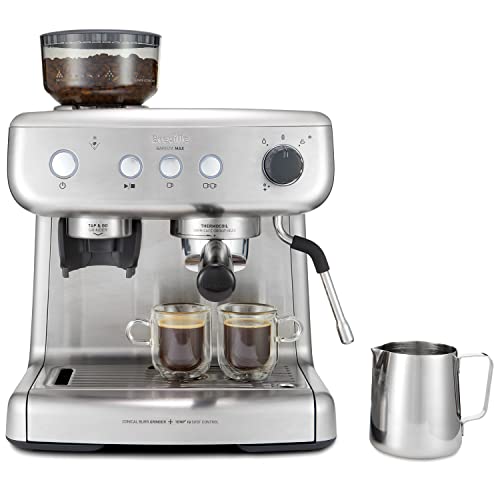

The Breville Barista Max at a competitive price and the De'Longhi Dedica Arte at £225 are the two budget contenders for UK buyers wanting proper home espresso under £350. The Barista Max includes an integrated grinder; the Dedica Arte is fully manual with no grinder. Two different approaches to delivering espresso at this price point.
This comparison covers which one fits which budget-conscious UK buyer.
Quick Verdict
The Breville Barista Max wins on integrated grinder convenience and the largest water tank in this price tier.
The De'Longhi Dedica Arte wins on price, the slimmest possible footprint, and offering proper espresso at the lowest credible entry point.
The deciding factor is whether you already have or plan to buy a separate grinder. With a grinder, the Dedica delivers comparable shots at lower total cost. Without one, the Barista Max's integrated grinder is the better path.
Side-by-Side Specs
| Spec | Breville Barista Max | De'Longhi Dedica Arte |
|---|---|---|
| UK price (Amazon) | £300 | £225 |
| Built-in grinder | Yes, integrated bean grinder | No |
| Milk system | Manual steam wand | MyLatteArt manual steam wand |
| Coffee input | Whole beans | Ground coffee only |
| Water tank | 2.8 L | Not specified (smaller) |
| Width | Not specified | 15 cm |
| Power | 1,100 W | Not specified |
| Pump | 15 bar Italian | Standard espresso pump |
| Body | Stainless steel | Beige (other colours available) |
Note: Breville UK is owned by Russell Hobbs and is a separate company from Sage (Australian Breville's UK brand name). The "Breville" name refers to different companies in different markets.
Price and UK Availability
Both widely stocked at Amazon UK, Currys, John Lewis, and AO. Both are also available at Argos and Sainsbury's Tu Home with broader high-street distribution than higher-tier machines.
The £75 price gap is modest in absolute terms but meaningful at this entry-level price tier (it's a 25 to 33 percent difference depending which direction). For some buyers, that £75 is the deal-breaker either way.
Design and Build Quality
The Breville Barista Max is a competent stainless steel machine with a top-mounted bean hopper, integrated grinder, and steam wand on the right. The 2.8-litre water tank is genuinely large for this price tier. Looks like a stainless steel kettle's bigger sibling.
The De'Longhi Dedica Arte is the famously slim 15 cm wide machine in beige (or other coloured finishes). No bean hopper - it has a portafilter dock and a small water tank. The form factor is much more compact than the Breville.
Build quality reflects the £75 price gap modestly. Both are appropriate for their price tier but use more plastic in non-critical paths than higher-end machines. For longevity, both should give 5 to 8 years of daily home use.
Espresso Shot Quality
Both produce home espresso. The Dedica marginally edges the Barista Max, but the gap is small enough to be statistical noise rather than a meaningful quality difference.
The Barista Max's "15 bar Italian pump" is standard espresso pump specification - actual brewing happens at approximately 9 bar at the puck on both machines. The 15-bar rating is marketing language common to most home espresso machines.
Neither machine specifies PID temperature control or pre-infusion. Both are competent for home espresso but neither pursues peak performance.
For shot quality, the two machines are essentially equivalent at this price point.
Built-in Grinder (or Lack of It)
This is the biggest functional difference.
The Breville Barista Max has an integrated bean grinder. You add whole beans to the hopper and the machine grinds them directly into the portafilter. No separate grinder needed.
The De'Longhi Dedica Arte has no grinder. You either use pre-ground coffee (significantly compromises quality) or buy a separate grinder. A capable budget burr grinder costs £100 to £200.
Total-cost picture: Barista Max alone costs £300. Dedica plus a budget grinder costs £325 to £425. So once you add a credible grinder, the Dedica becomes more expensive than the Barista Max.
For buyers willing to use pre-ground coffee, the Dedica saves money. For buyers who want quality espresso (which requires fresh-ground beans), the Barista Max is the better total-cost option at this tier.
Milk Frothing
Both use manual steam wands. The Dedica's is the "MyLatteArt" wand designed for beginner accessibility. The Barista Max uses a conventional manual steam wand.
Both require manual technique. Both produce microfoam in trained hands. Steam pressure on the Barista Max is somewhat higher, which makes microfoam faster to produce once you have technique.
Neither is automatic. Both require 2 to 6 weeks of practice to consistently produce silky milk.
Daily Operation and Learning Curve
Both warm up in 2 to 4 minutes from cold. Both produce a shot in under 90 seconds once warm.
The Barista Max's workflow: add beans to hopper (one-time), power on, wait for warm-up, place portafilter and let machine grind directly into it, tamp, lock in, brew. Steam milk separately.
The Dedica's workflow: power on, wait for warm-up, grind beans on separate grinder, dose into portafilter, tamp, lock in, brew. Steam milk separately.
The Barista Max removes the separate-grinder workflow step. The Dedica requires you to manage the grinder workflow yourself.
The 2.8-litre water tank on the Barista Max is genuinely useful for households making 6+ drinks per day. The Dedica's smaller tank requires more frequent refills.
Cleaning and Maintenance
Similar daily and weekly cleaning. Drip tray, steam wand, portafilter, group head wipe. Weekly backflush. Monthly descale per UK water hardness.
The Barista Max's integrated grinder adds occasional brush-out cleaning to remove coffee oil buildup. The Dedica has no internal grinder so no grinder cleaning.
Annual maintenance cost is roughly £15 to £30 for either machine.
Who Should Buy the Breville Barista Max
You'll enjoy the Barista Max if you don't own a grinder and don't want to buy one separately; or if your household makes many drinks per day (the 2.8 L tank capacity matters); or if you want one machine to handle the whole espresso workflow at the lowest price; or if you prefer mainstream UK kitchen-appliance brand distribution.
Skip the Barista Max if you already own a quality grinder, or if your kitchen needs the Dedica's slim 15 cm footprint, or if the £75 saving on the Dedica is meaningful to your budget and you're prepared to buy a grinder later.
Who Should Buy the De'Longhi Dedica Arte
You'll enjoy the Dedica Arte if you already own or plan to buy a separate grinder; or if your UK kitchen has very limited counter width; or if you're testing whether home espresso suits your routine and want the cheapest credible entry; or if the coloured finishes (beige, white, grey) appeal more than industrial stainless steel.
Skip the Dedica Arte if you don't have a grinder and don't want to buy one (the Barista Max's integrated grinder solves this for £75 more), or if you make many drinks per day (the Barista Max's larger water tank matters), or if your kitchen has space for a wider machine.
Final Verdict
For UK buyers without an existing grinder, the Breville Barista Max at a competitive price is the better total-cost choice. The integrated grinder saves the £150 to £400 separate grinder purchase, which means the Barista Max alone produces better espresso than the Dedica with pre-ground supermarket coffee.
For UK buyers with a grinder already, or who own a slim 15 cm kitchen, or who plan to add a grinder anyway, the De'Longhi Dedica Arte at a competitive price is the better choice. The slimmer footprint and lower entry price work in its favour.
These two machines actually serve different buyer profiles cleanly once you factor in the grinder question. Neither is universally better.
For deeper context see our Breville Barista Max review and De'Longhi Dedica Arte review. For upgrade paths see Breville Barista Max vs Sage Barista Express or Sage Bambino vs De'Longhi Dedica Arte.
Frequently Asked Questions
Which produces better espresso?
Both have nearly identical Amazon ratings suggesting comparable shot quality satisfaction. The Barista Max's advantage is the integrated grinder ensures fresh-ground beans; the Dedica relies on you providing quality ground coffee. With pre-ground supermarket coffee on both, the Barista Max's freshly-ground output wins.
Is the £75 gap significant?
At absolute price it's modest. As a percentage of the entry-level price tier, it's 25 to 33 percent which is meaningful for budget-constrained buyers. Whether it's worth paying depends on whether you also need to budget for a grinder.
Which fits the smallest UK kitchens?
The De'Longhi Dedica Arte at 15 cm wide is decisively narrower. It fits in kitchens where the Barista Max wouldn't.
Which has stronger UK customer service?
Both have established UK service networks. Breville (Russell Hobbs) has broader high-street retail presence; De'Longhi has more specialist coffee retailer presence. Anecdotally both are similar quality for routine service.
Will either replace a bean-to-cup machine?
Neither. Both require manual portafilter handling and manual milk steaming. For "press button, drink appears" workflow, look at fully automatic bean-to-cup machines instead.
Compare to Other Alternatives
Still deciding? See how this machine stacks up against the alternatives UK buyers consider: