
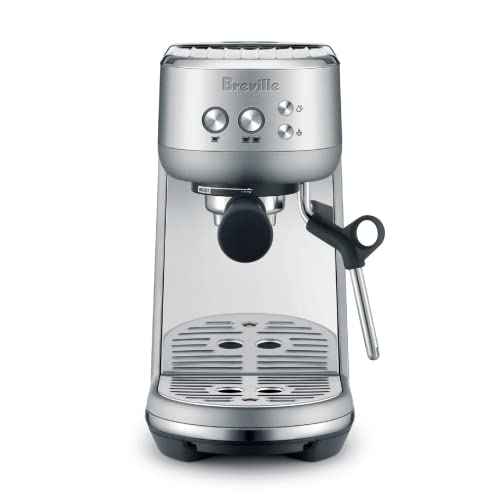
The KitchenAid Artisan Semi-Auto at a competitive price and the Sage Bambino at a competitive price are entry-level espresso machines aimed at UK home buyers exploring espresso for the first time. Both are compact. Both lack integrated grinders. Both use manual steam wands. The price gap is £214, which means very different total-cost positions for budget-conscious buyers.
This comparison covers whether the Sage Bambino's £214 premium is justified versus the KitchenAid's lower entry point.
Quick Verdict
The KitchenAid Artisan wins on price (a competitive price less), brand design statement for buyers in the KitchenAid ecosystem, and offering proper espresso at one of the lowest credible price points in the UK.
The Sage Bambino wins on build refinement (heavier-gauge construction, ThermoJet near-instant warm-up), customer satisfaction track record, and the broader Sage product family ecosystem.
The deciding factor is your budget tolerance and how much you value Sage's refinement at this entry tier. The KitchenAid is the rational starter machine. The Bambino is the better long-term machine if budget allows.
Side-by-Side Specs
| Spec | KitchenAid Artisan | Sage Bambino |
|---|---|---|
| UK price (Amazon) | £225 | £439 |
| Built-in grinder | No | No |
| Milk system | Manual steam wand | Manual steam wand |
| Coffee input | Ground coffee only | Ground coffee only |
| Body | Cast Iron Black (other colours available) | Stainless steel |
| Heat-up | Conventional thermocoil | ThermoJet (~3 sec) |
| Origin | American brand (manufacturing varies) | Australian (Sage/Breville) |
Detailed dimensional specs (water tank, exact width, wattage, boiler type) are not consistently published in the Amazon UK listings.
Price and UK Availability
Both stocked at Amazon UK, Currys, John Lewis, and AO. The KitchenAid is additionally available at Argos and through KitchenAid-direct channels. The Bambino is more often found in specialist coffee retailers like Bella Barista and Coffee Hit.
The £214 price gap is substantial relative to the entry tier (a 95 percent increase). For budget-conscious buyers, that £214 is the difference between starting home espresso this month or saving for several months. For buyers with flexibility, the gap funds better beans, accessories, or a grinder upgrade alongside either machine.
Design and Build Quality
The KitchenAid Artisan brings the KitchenAid design language to espresso. Cast Iron Black is the standard finish with other colours available. The aesthetic matches the broader KitchenAid kitchen lineup for buyers already in the ecosystem.
The Sage Bambino is the compact Sage aesthetic - brushed stainless steel, modern lines, more industrial than the KitchenAid's designer-appliance look. Designed for small kitchens but with more substantial construction.
Build quality reflects the £214 price gap. The Sage uses heavier-gauge materials and a more refined construction. The KitchenAid is competent for £225 but uses more plastic in non-critical paths.
For longevity expectations: KitchenAid 5 to 8 years of daily use, Sage Bambino 8 to 12 years.
Espresso Shot Quality
Both produce home espresso with comparable customer ratings. Both are well-rated, which suggests similar satisfaction levels relative to expectations at each price point.
The Sage Bambino's brewing path is more refined: better heat retention, more consistent shot temperatures, slightly more forgiving with bean variation. The KitchenAid produces respectable shots but with more variability shot-to-shot.
For most home users this difference is minor. Both significantly exceed what supermarket pod machines produce. Both work best with fresh-ground beans from a quality grinder.
The Sage's ThermoJet heating system is notably faster from cold (around 3 seconds) than the KitchenAid's conventional thermocoil. For weekday convenience this is a meaningful difference.
Built-in Grinder (or Lack of It)
Neither machine has an integrated grinder. Both expect ground coffee in a portafilter.
This is the shared hidden cost. A capable espresso grinder costs £150 to £400. For the KitchenAid buyer, this nearly doubles total cost. For the Bambino buyer, it's a smaller proportional increase but still significant.
The cheapest credible path to good home espresso is KitchenAid Artisan plus a budget burr grinder (Hario Skerton manual, Baratza Encore basic): total around £325 to £375 - still less than the Bambino alone.
Milk Frothing
Both use manual steam wands. Both require manual technique. Both produce microfoam in trained hands.
The Sage Bambino's steam pressure is somewhat higher than the KitchenAid's, making microfoam faster to produce once you have technique. The KitchenAid's lower steam pressure is more forgiving for beginners but slower to texture milk.
Neither is automatic. Skills transfer between machines.
Daily Operation and Learning Curve
The Sage Bambino warms up in roughly 3 seconds (ThermoJet) and produces a shot within 30 to 60 seconds of power-on. The KitchenAid Artisan takes 2 to 3 minutes from cold start.
For weekday morning convenience, the Bambino's faster warm-up is a real quality-of-life difference. For weekend ritual or relaxed coffee preparation, the KitchenAid's slower warm-up doesn't matter.
Learning curve is similar on both. Both demand the same fundamental skills (grind, dose, tamp, brew, steam). Skills transfer between the two.
Cleaning and Maintenance
Similar daily and weekly cleaning routines. Drip tray, steam wand, portafilter rinse, weekly group head wipe, monthly descale per UK water hardness.
The Bambino is the easier machine to maintain through Sage UK service. The KitchenAid is more typically serviced through general kitchen appliance support rather than specialist coffee channels.
Annual maintenance cost is roughly £15 to £30 for either machine.
Who Should Buy the KitchenAid Artisan
You'll enjoy the KitchenAid Artisan if budget is the primary constraint (a competitive price saving is substantial); or if you're already invested in the KitchenAid kitchen ecosystem (stand mixer, food processor); or if you want a design statement rather than industrial stainless steel; or if you're testing whether home espresso suits your routine before committing larger budget.
Skip the KitchenAid Artisan if you can comfortably afford the Bambino, or if you specifically value Sage's product family ecosystem and ThermoJet warm-up, or if the larger review base on the Bambino gives you more confidence.
Who Should Buy the Sage Bambino
You'll enjoy the Bambino if you want Sage build quality at the lowest Sage price; or if you value ThermoJet near-instant warm-up; or if the broader Sage product family appeals as a future upgrade path; or if the much larger Amazon review base gives you more confidence in the model; or if you can comfortably afford £439.
Skip the Bambino if budget matters and £214 less on the KitchenAid is meaningful, or if the KitchenAid design statement appeals to you, or if you're testing whether home espresso suits your routine.
Final Verdict
For UK buyers on tight budgets or in the KitchenAid ecosystem, the KitchenAid Artisan at a competitive price is the right entry point. The price is approachable and the design statement adds value beyond pure espresso performance.
For UK buyers who can comfortably afford the upgrade, the Sage Bambino at a competitive price delivers materially better build quality, faster warm-up via ThermoJet, and a more refined daily experience. The much larger review base also provides stronger customer satisfaction signal.
Both are credible entry points into proper home espresso. The KitchenAid wins on price and design; the Bambino wins on refinement and brand ecosystem.
For deeper context see our KitchenAid Artisan review and Sage Bambino review. For the upgrade path within KitchenAid see KitchenAid Artisan vs KES6403.
Frequently Asked Questions
Is the Bambino really worth £214 more than the Artisan?
For buyers committed to home espresso as an ongoing hobby and who can afford it, yes - Sage's refinement, ThermoJet warm-up, and longer expected lifespan justify the premium. For budget-conscious buyers or those testing home espresso, the KitchenAid Artisan at £225 is the rational starting point.
Can the KitchenAid produce shots as good as the Bambino?
With identical beans, identical grind, and identical technique, the Bambino's shots will be marginally more consistent. The difference is real but modest. Most home users would not consistently identify which machine produced which shot in a blind taste test.
Which has stronger UK customer service?
Sage has more specialist coffee community support and authorised service centres focused on espresso machines. KitchenAid has broader general kitchen appliance retail support but less specialist coffee-focused service.
Will either replace a bean-to-cup machine?
Neither. Both require manual portafilter handling and manual milk steaming. For one-button workflow look at fully automatic bean-to-cup machines instead.
Which is better for first-time home espresso buyers?
Both are appropriate entry-level choices. The KitchenAid is more accessible budget-wise; the Bambino has a more developed user community sharing tips and accessories on UK coffee forums.
Compare to Other Alternatives
Still deciding? See how this machine stacks up against the alternatives UK buyers consider: